By Peter Metcalf
Executive Director
Trump Administration proposed rescission of the Roadless Rule threatens Badger-Two Medicine and adjacent National Forest lands
The Department of Agriculture is proposing to rollback a 24-year old policy that limits road building and logging in national forest roadless areas
One of the most substantive and effective conservation policies for the Badger-Two Medicine and other national forest roadless areas is firmly in the cross hairs of the Trump Administration.
In late June, right at the peak of the fight to stop the sale of public lands, Secretary of Agriculture Brooke Rollins announced that the US Department of Agriculture planned to rescind the 2001 Roadless Area Conservation Rule, better known as the Roadless Rule.
This highly effective conservation policy limits new road construction, the reconstruction of existing roads, and commercial logging on approximately 45 million acres of national forest lands, including more than 6 million acres in Montana, classified as Inventoried Roadless Areas (Colorado and Idaho contain another 13 million acres of Inventoried Roadless Areas, but have separate Rules which are not affected by the proposed rescission). The Roadless Rule does provide some notable exceptions to these limitations, including the removal of small diameter timber to reduce the risk of uncharacteristic wildfires or for forest restoration, or road construction for public safety.
Inventoried Roadless Areas like the Badger-Two Medicine are some of the wildest, most intact and healthy national forest lands that remain outside of Congressionally-protected areas like Wilderness. They provide some of the absolute best habitat security for elk, grizzly bears and other wildlife, contain some of the healthiest native trout waters around, and are more resilient to wildfires, invasive species or the effects of climate change. Roadless areas protect intact watersheds that provide clean water for drinking or agriculture.
The loss of the Rule would make some of our most outstanding, unprotected wild places like the Badger-Two Medicine or parts of the Flathead National Forest vulnerable to future road construction, logging and other development activities.
The Roadless Rule and Badger-Two Medicine
More than 75% of the Badger-Two Medicine is classified as an Inventoried Roadless Area and thus protected by the Roadless Rule. The Roadless Rule, according to our friend and attorney Tim Preso at Earthjustice, provides the most substantive, enforceable protections against development and industrialization of the Badger Two Medicine aside from the 2006 Congressional mineral withdrawal that prohibits new oil and gas leasing or hard rock mineral exploration. By comparison, the Forest Plan’s components, as good as they are, tend to be less legally binding on the agency, while the Traditional Cultural District only imposes procedural obligations on the Forest Service to consider, not necessarily avoid, any adverse effects its actions may have on Blackfeet cultural resources and values.
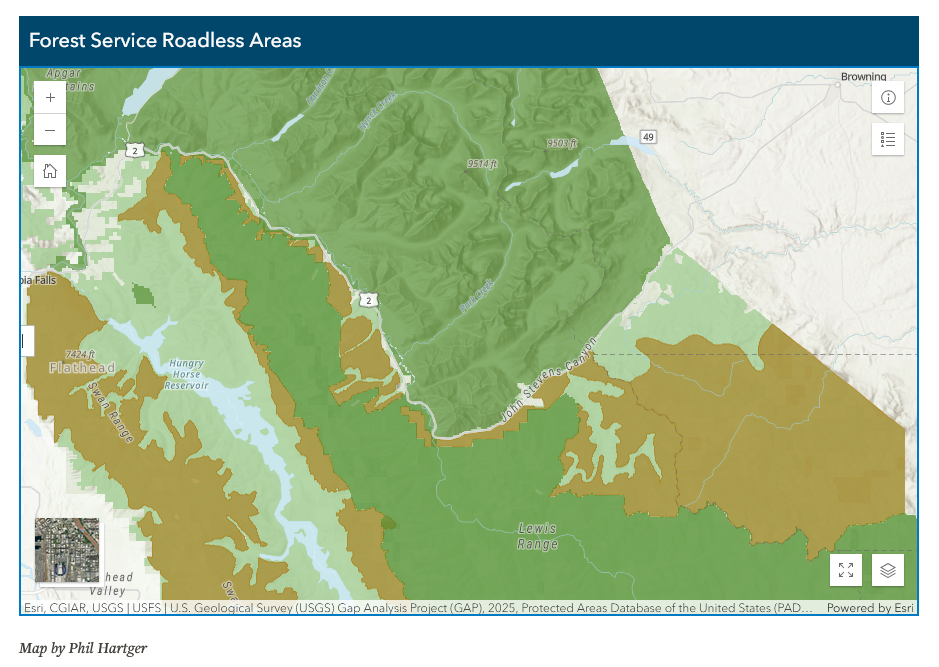
This detail of a map from our friends at The Wilderness Society shows roadless areas in GTMA’s mission area in brown, unprotected national forest lands in lime green, and the Great Beaer Wilderness / Glacier National Park in dark green. Check out their map to see other affected national forest lands across the country.
Adjacent National Forest Lands at Risk
It’s not just the Badger- Two Medicine that is at risk in our mission area. The Roadless Rule applies to about 42,000 acres of the Flathead National Forest between Marias Pass and West Glacier in the US-2 corridor, including the Slippery Bill-Puzzle recommended wilderness area, and most other national forest lands in this corridor outside of the Great Bear Wilderness. Like many roadless areas, these lands are steep and rugged. They protect important native trout spawning streams and big game habitat, as well as are a favorite place to backcountry hunt or ski.
Roadless Rule Aids Endangered Species Recovery
But it’s not just wild national forest lands that this proposal puts at risk, it’s also the recovery, and eventual delisting, of Threatened and Endangered Species like grizzly bears, Canada lynx or bull trout. These species absolutely depends on the secure, intact habitat roadless areas provide in order to recover and connect their populations by avoiding human-caused mortality. The US Fish and Wildlife Service meanwhile, relies on policies like the Roadless Rule when making its determination whether there are sufficient legal safeguards in place to maintain habitat protections after a species is delisted. Ironically, given that some of the advocates for rescinding the Roadless Rule are also some of the strongest advocates to prematurely delist grizzly bears, the rescission of the Roadless Rule will make it more difficult for grizzly bears to meet the minimum legal thresholds necessary to be delisted.
What’s Next [Updated]
On August 29th, the USDA officially began the process of rescinding the Roadless Rule when it published its Notice of Intent in the federal register. The public is encouraged to comment (against!) the rescission until Sept. 19th. The Department anticipates completing the draft Environmental Impact Statement on the proposed rescission in March, at which time the public will have another opportunity to comment. The original Rule generated 1.6 million public comments, with 95% in favor of its protections. Let’s send another strong message that our precious few remaining roadless areas should not be developed.
Learn More
Listen to this excellent interview with Chris Wood, architect of the Roadless Rule, and President of Trout Unlimited – From our friends at Wild Idea Media.
What Could the end of the Roadless Rule mean for Montana’s National Forests? – Flathead Beacon